
Pasco Previous Residents by Era
A Pasco address history needs several dated layers. Recent parcel and deed records identify a tax owner and recorded transfer parties. Earlier work may require deed books at the Franklin County counter. Maps establish where a building or block existed, while directories show a dated occupant or telephone-subscriber listing. Each source has a narrow job.
| Source | Years It Covers | Where Held | What It Shows |
|---|---|---|---|
| Tax Search and FRIS | Current portal data | Franklin County | Owner, parcel, map, sale lead, legal description |
| Recorded land index | 1989 to present | Washington State Archives | Grantor, grantee, type, year, image when available |
| Deed books and indexes | Before 1989 | Franklin County Recording | Book page, legal description, indexed parties |
| Polk and telephone volumes | 1910 to 1918; 1949 to 2025 with gaps | State and local libraries | Dated occupant or subscriber listing |
| Maps and newspapers | 1891 onward, with gaps | Library of Congress and local repositories | Building, block, street, obituary, life events |
Ownership history and occupancy history are not interchangeable. A deed does not name every person in the home. A directory can be stale. Agreement among independent records supports careful statements about previous residents.
Pasco Previous Residents in Deeds
The Washington State Archives recorded land portal is the practical online start for a Franklin County chain. At inspection it held 535,169 records from 1989 forward. Search controls include party last name or company, first and middle names, Soundex, party type, addition name, year range, and document type. Current-year material can lag periodic transfers. Images may be omitted when confidential information is involved.
The index includes deeds and documents that do not transfer title. Deeds of trust, assignments, trustee substitutions, notices, reconveyances, liens, and releases can explain the parcel's record trail, but they are not all owner changes. Classify the instrument before adding a name to the chain of previous residents.
The Archives search form displays the party, Soundex, addition, year, and type controls.
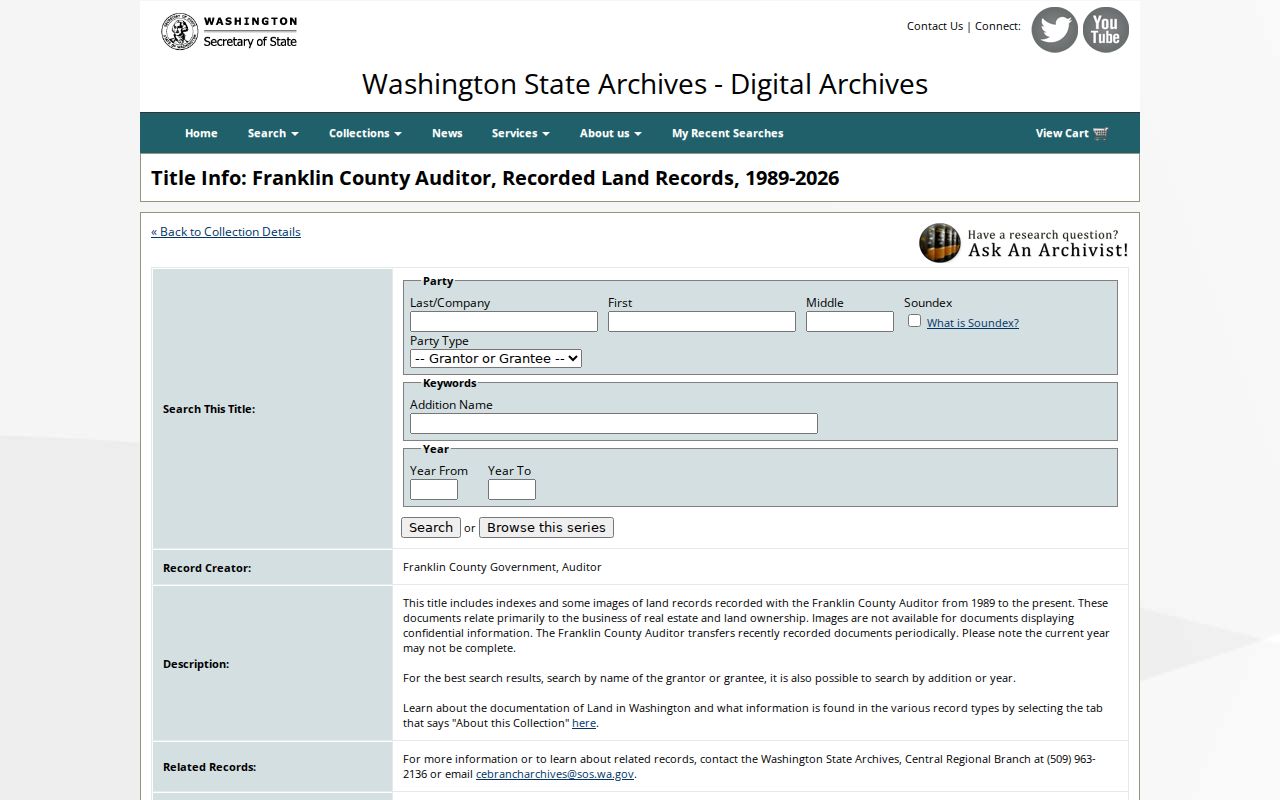
Those fields help separate similar names and narrow results to the addition and date tied to the parcel.
Trace Pasco Owners Backward
Begin with the current parcel in Tax Search or FRIS. Copy the parcel number, situs address, exact owner spelling, and legal description. Then work through recorded instruments one transfer at a time. This guards against same-name errors and parcel numbers changed by a split, consolidation, or annexation.
- Find the parcel and note its owner, legal description, source date, and latest sale only as a lead.
- Search the newest conveyance by current grantee, year, and deed type. Inspect its image and Auditor File Number.
- Take that deed's seller, or grantor, and search that party as a grantee for the earlier purchase.
- Repeat while the legal description matches. Keep instrument date and recording date in separate fields.
- Before 1989, ask Recording about deed books, party indexes, plats, microfilm, and copy options.
- Grantor and grantee
- The grantor conveys an interest; the grantee receives it.
- Chain of title
- The sequence of recorded transfers affecting the same land.
- Legal description
- Lot, block, addition, section, or bounds language that identifies land more reliably than an old street label.
- AFN
- The Auditor File Number assigned to a recorded instrument.
Earlier Pasco Address Records
The exact pre-1989 online cutoff and deed-book inventory were not found in the official sources reviewed. The Franklin County Recording counter is therefore the fallback. Ask what the public may inspect among deed books, grantor and grantee indexes, plat books, microfilm, AFN references, and copies. A focused request names the parcel or legal description, date range, and desired instrument fields.
Request deeds, trustee's deeds, easements, liens, releases, and reconveyances affecting the land, along with recording date, instrument type, index names, and image status. Inspection may be more useful than broad copies. Do not ask staff to compile unrelated facts about private people.
Note: Preserve both the deed date and recording date because they can differ and each may matter in a house chronology.
Pasco Records for Previous Residents
Old labels can break a sound address search. Pasco's 1974 street-renaming hearing described a proposed 1976 system that kept street numbers while adding an alphabetic naming logic. Staff sought less confusion, room for growth, and fewer duplicate names with Kennewick and Richland. Opposition included about 1,528 signatures and concern for Pasco's heritage.
For previous residents, the minutes work as a translation clue. Keep the house number, compare block geography, test both old and present street labels, and consult the 1917 Pasco map and historical street-name material. A name match alone is weak. The number, block, dated map, directory page, and legal description make a firmer bridge.
Map an Older Pasco House
The Library of Congress Pasco Sanborn sheet fixes the built setting in 1891. It can show a footprint, use, block, and street context, but it cannot prove title or name an occupant. The Franklin County Historical Society index adds a 1917 Pasco map, a history through 1915, street-name material, and a 1906 telephone-installation ordinance. These sources place an old address before modern parcel IDs.
Modern records provide another time layer. FRIS shows parcels, roads, addresses, plats, photos, sale information, and city limits. Pasco eTRAKiT can show parcel facts, permits, inspections, and chronology where records are available. Compare the dated old map with current geometry only after confirming the spot. The same written address may not mean the same building use over time.
Pasco Past Households in Print
A title chain supplies owners, while print may identify who was listed there. Washington State Library holdings include Polk county directories from 1910 through 1918 and Pasco-Kennewick or Tri-City runs from 1952 through 2025, with missing years. Telephone books cover 1949 through 2015 with gaps. Read the reverse or street section first, then check the name. The shelves are covered on the Pasco city directory page.
Pair directories with census and other dated records:
- Save the edition title, year, page, address, and name exactly as printed.
- Check nearby editions to see when the listing appears and changes.
- Compare the census household and enumeration geography, not the name alone.
- Keep deed owner and listed occupant in separate columns, noting agreement or conflict.
- Use newspapers, cemetery records, and probate to test moves, deaths, heirs, and later links.
- Criss-cross directory
- A volume arranged by street or telephone number, not just surname.
- Enumeration district
- The small area assigned to a census taker, useful when there is no address index.
Close a Pasco Resident Trail
Mid-Columbia Libraries has an obituary spreadsheet covering 1905 through 2020, local newspaper resources, and long microfilm runs. Search name variants, then verify an index hit against the issue. City View Cemetery, founded in 1923, offers an electronic search and local context through its veteran and railroad memorials. A cemetery match supports a family or death lead, not occupancy at the target house.
Probate can identify an estate, heirs, or a transfer after death. Franklin County's Superior Court Clerk holds probate files. Match a case to the full name, date range, parcel, deed, or obituary before treating it as part of the Pasco trail. This check may explain why an owner changes or why a deed is signed by a personal representative.
Lawful use. Research Pasco previous residents for family history, house history, or personal curiosity. Never use an address trail to watch, harass, or harm a living person.